MCP Registries in Mid-2026: One Upstream Won
I deleted my 26,708-server scraped MCP catalog and rebuilt on the official registry. The field report, half length.
July 2026 · Read the full article on Medium →
In May I wrote that my vibe-coded catalog indexed 26,708 Model Context Protocol servers and that the next move was a pivot from breadth to trust. Last week I finished that pivot by deleting the catalog. mcpxhub.io now answers with 1,007 redirects, all pointing at the rebuild: catalog.agentage.io. The rebuild holds about ten thousand fewer servers. That's the upgrade.
#The number I bragged about was the problem
A crawler can verify that a repo looks like an MCP server. It cannot verify that anyone owns it, that the npm package belongs to the repo, or that the hosted URL is operated by the name on the tin. Scraped breadth is a pile of unverifiable claims with great SEO.
Meanwhile the official MCP Registry went live at registry.modelcontextprotocol.io (still formally a preview; API frozen at v0.1). It holds roughly 16,967 published servers as of July 16, 2026, and every one got there the same way: a publisher proved ownership of a namespace and signed a record. Nobody crawled anything.
26,708 scraped beats 16,967 verified on a homepage. It loses everywhere else.
#One upstream, many views
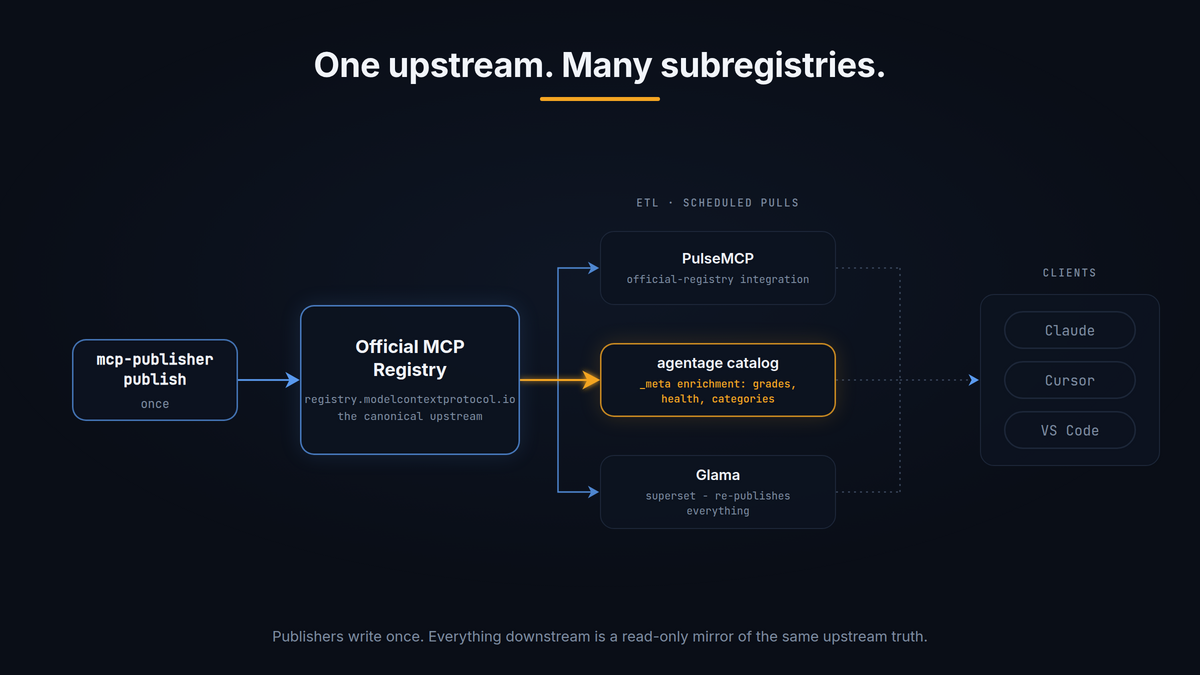
Catalogs are becoming views of the same upstream, each adding a different lens: PulseMCP layers editorial curation and a newsletter, Glama re-publishes everything plus data from running servers in its own sandboxes, and agentage crawls /v0.1/servers daily and adds computed grades and health probes.
Not everyone is fully in. GitHub's MCP registry is a separate curated catalog (interop planned, not mirroring); Smithery publishes into the registry but has never stated it sources from it. Convergence is the settled direction, not a completed migration.
The payoff for a server author: publish once, appear everywhere. One mcp-publisher publish and your server shows up in PulseMCP, Glama, and agentage within a day, carried by their ETL jobs. The five-directory submission grind of 2025 is ending.
#There are exactly two doors in
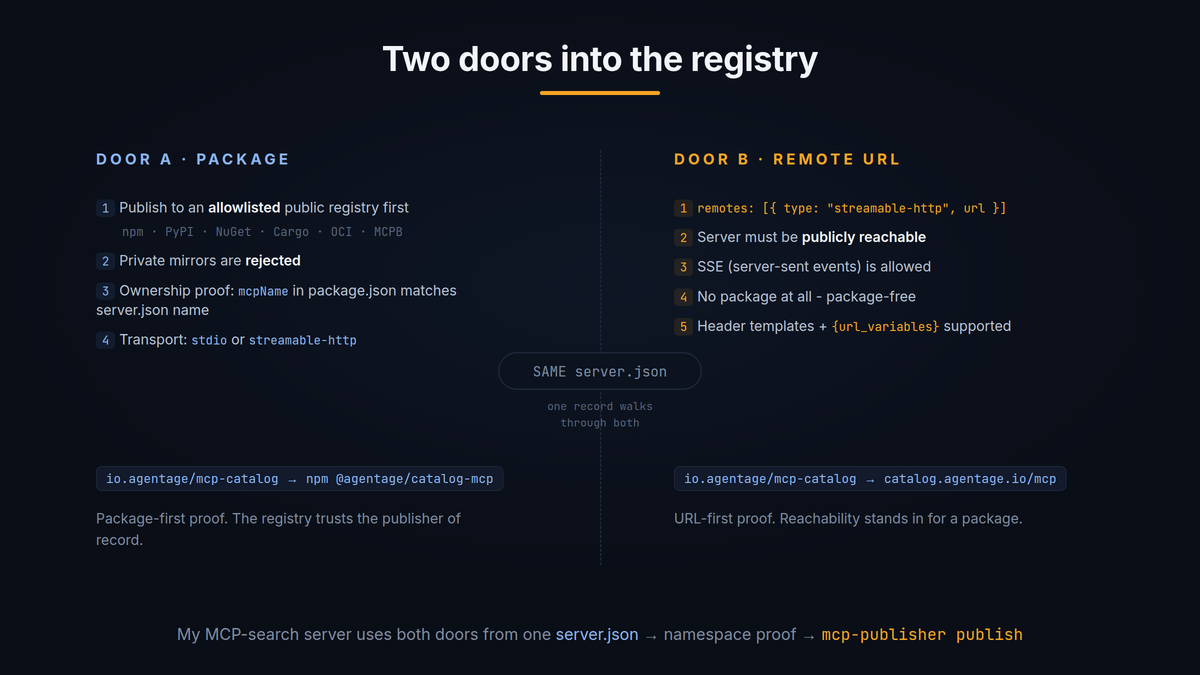
The registry hosts metadata, never artifacts. Door A: a package on an allowlisted public registry (npm, PyPI, NuGet, Cargo, OCI images, MCPB binaries); base URLs are pinned, and ownership is proven inside the artifact - for npm, a mcpName field in package.json must match the server.json name exactly. Door B: a remote URL - a publicly reachable streamable-http (or SSE) endpoint in a remotes array.
My MCP-search server walks both from a single record: io.agentage/mcp-catalog ships as @agentage/catalog-mcp on npm and as the hosted endpoint catalog.agentage.io/mcp. The schema is stricter than you'd guess: descriptions are capped at 100 characters, enforced.
#Subregistries are the architecture
The registry's own ecosystem vision says subregistries "add value to the registry ecosystem by providing curation, or extending it with additional metadata", and that it "expects a lot of API requests from ETL jobs". Enrichment lives in namespaced _meta blocks, so downstream catalogs annotate the canonical record instead of forking it. Aggregating isn't parasitism; it's the deployment model.
My rebuild consumes /v0.1/servers, re-serves the same v0.1 contract with enrichment under io.agentage.catalog/v0, and is itself published into the registry it serves. If the contract drifts, I break myself first.
#The hosted-publish recipe, compressed
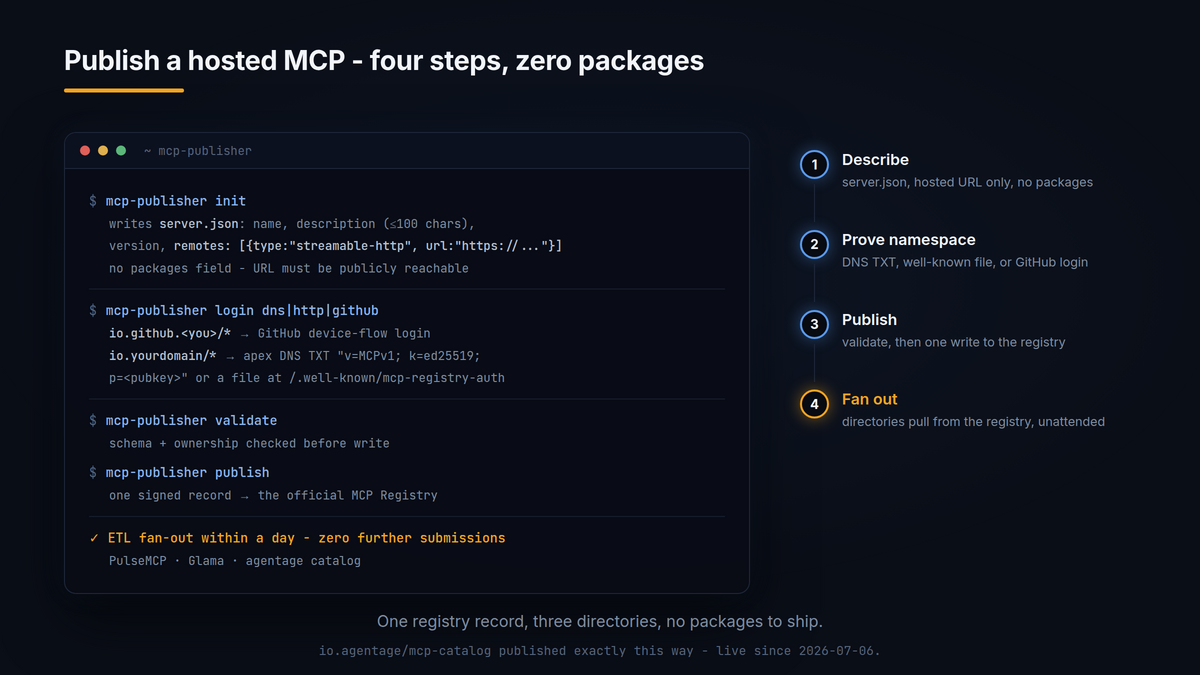
- Describe it.
mcp-publisher init, then four fields and nopackagesat all: name, description (you get 100 characters), version, and aremotesarray with yourstreamable-httpURL. - Prove the namespace.
io.github.<you>/*costs one GitHub device-flow login. A branded namespace needs an apex-domain proof: a DNS TXT record (v=MCPv1; k=ed25519; p=<public-key>) or the same key at/.well-known/mcp-registry-auth. DNS is the lower-risk default; the keypair needs OpenSSL 3. - Ship it.
mcp-publisher validate, thenmcp-publisher publish. - Do nothing. The ETL wave distributes.
io.agentage/mcp-catalogwent live on July 6, 2026 exactly this way; PulseMCP lists it, Glama picked up my memory server through the same pipe. I never filled in a form on either.
#The registry verifies ownership, not quality
It proves who published, nothing else - a verified namespace can still register a look-alike mcp-server-postgress. That gap is where catalogs now compete. Managed hosting buys convenience and concentrates risk (the June 2025 path-traversal flaw in Smithery's hosting layer exposed 3,000+ hosted servers). For the rebuild I stuck to computed signals: A-F grades kept separate, live health probes, AI categorization, no crowd reviews to game, no hosting to breach.
Trust is the moat now. Breadth is a
curlaway for anyone.
What none of this tells you yet: whether a server's tools are actually callable by real models, end to end, across vendors. That's measurable, and it's the next article: a cross-model routability score for MCP servers.
Read the full article on Medium → - the complete field report with the real server.json, the namespace-proof details, and the receipts.
Related: catalog.agentage.io · the May prequel · @vreshch on GitHub